From saved places to a day that feels personal.
Veyra connects discovery, route planning, and flexible itineraries in one clear experience.
ExploreFind a place.
CollectAdd it to the day.
ArrangeMake the route work.
PROJECT SNAPSHOT · Independent product exploration · Current local prototype
From a saved place to a recoverable day plan.
Explore places, build a day route and adjust it as travel plans change.
- My contribution
- Journey design, wireframes, interface direction and an interactive planning study.
- Status
- Interactive prototype v2 · validation planned
- Read this case for
- Places before configuration. Reversible changes. Show unresolved constraints.
Audience, delivery context and scope
- Primary task and audience
- Travelers who want to build and adjust a one-day itinerary.
- User problem
- Saved places do not explain which visits fit together or what a change does to the rest of the day.
- Constraint shaping the decision
- The local prototype has illustrative geography, visit times and access notes, with no live routing or ticket service.
- Current artifact
- Map-first local planner is the current reference. The earlier configure-first Figma flow remains labeled Version 1.
- Delivery record
- Portfolio iteration: 20 October 2026. The original project duration, feedback attribution, traveler research and a comparative outcome study are not recorded.
- MVP boundary
- Live directions, reservations, access verification and multi-day optimization; the MVP is one recoverable day.
The experience / See it in motion
One place.
A day taking shape.
Follow a place from the map into your itinerary.
ROME A day of your own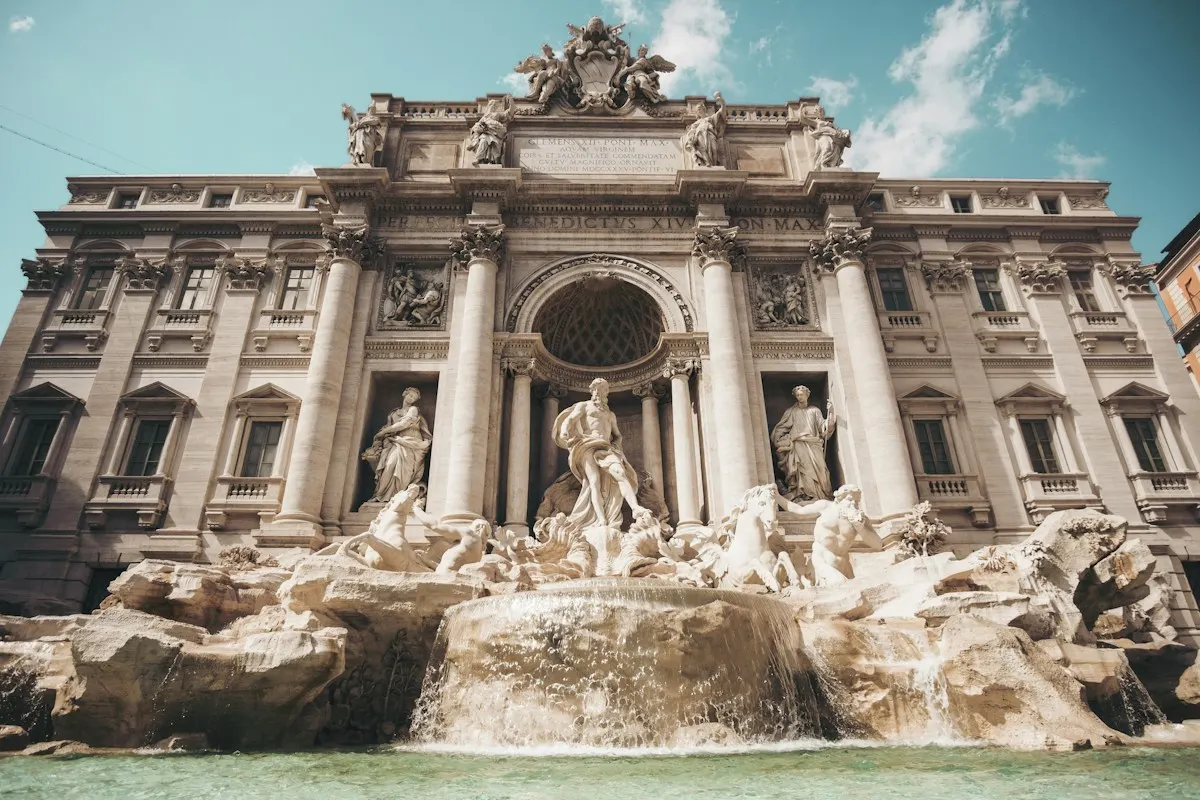 1
 2
 3Travel-planning walkthrough
12301 / EXPLORE
A place catches your eye.
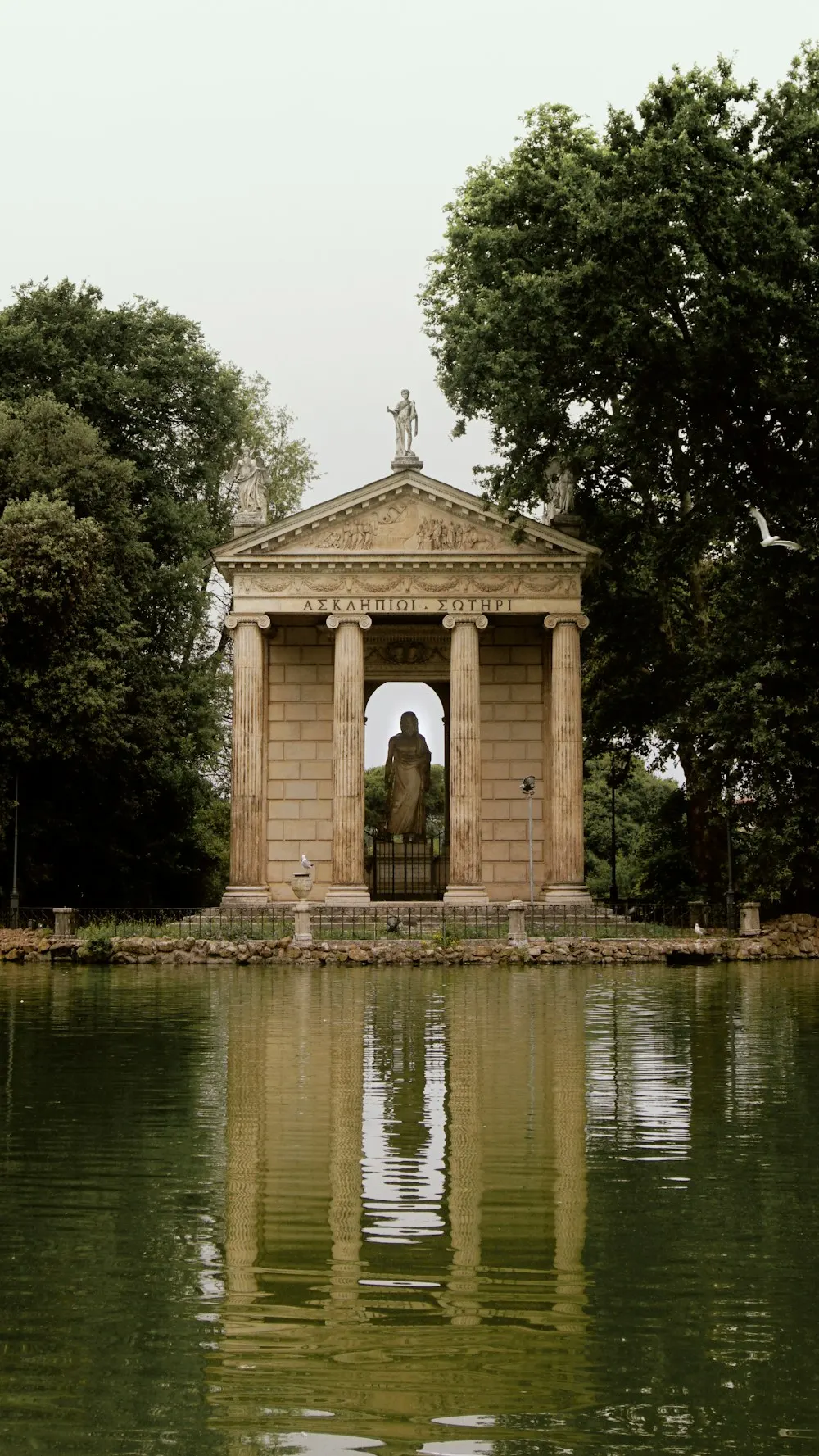
Villa Borghese gardensA softer side of Rome · 75 min
YOUR DAY / ROME
1 Trevi Fountain
2 Villa Borghese gardens Added
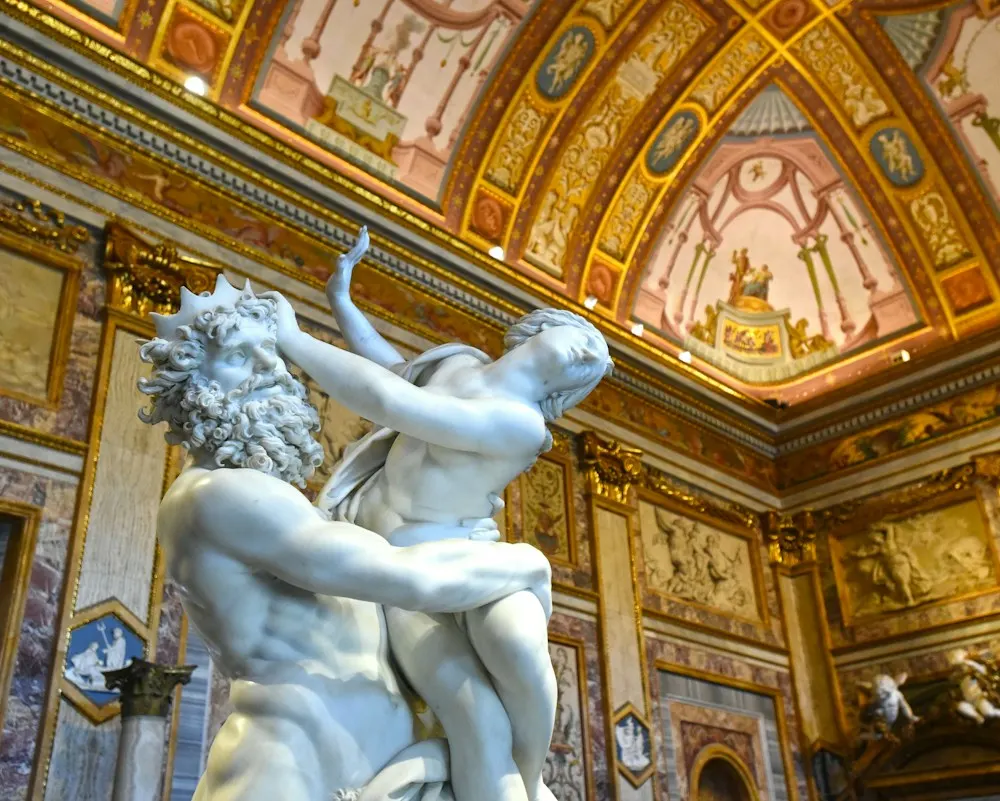
3 Galleria Borghese
Open a photo pin to see what makes a place worth your time.
A three-step walkthrough of the experience. Use the steps or play once.
The problem in three moments
Great places.
A day that doesn’t quite fit.
What fits together?
One change, many doubts.
Working hypotheses for traveler research.
02 / Understand
Less organizing.
More looking forward to it.
A CITY TO EXPERIENCE,NOT A LIST TO COMPLETE.
Working audience / The thoughtful organizer
“A good day together.
Not another project to manage.”
Core job statement.
- Wants
- Discovery with room to change direction.
- Needs
- Nearby places, realistic timing, clear ticket needs.
- Fears
- A packed schedule that becomes everyone’s problem.
THE FEEDBACK THAT CHANGED THE DESIGNToo many selections.
Too many selections.
Not enough sense of the city.
Project review prompted a shift from text-led setup to visual exploration.
03 / Define the opportunity
How might we turn
“I’d love to go there” into
“this day feels like us”?
Inspire before askingKeep context visibleMake change reversible
Experience mapping
One continuous journey.
Different kinds of care.
From the first saved place to a change of plan, keep the next step clear.
“That looks like us.”
Explore the city through places and photographs.
Curiosity
Design responseMap + photo cards“Let’s make time for it.”
Understand a place and add it to the right day.
Anticipation
Design responsePlace detail + day tray“Does this work?”
See the route, timing and unresolved decisions.
Uncertainty to clarity
Design responseRoute + editable stops“Are we ready?”
Separate a saved idea from a confirmed booking.
Reassurance
Design responseStatus + essentials“What can we change?”
Replace one stop without losing the rest.
Concern to control
Design responseCompare + undoHypothesized emotional journey, not a measured sentiment study. Swipe horizontally on smaller screens.
See the service considerations behind the journey
| Experience promise | Production dependency | Honest interface behavior |
|---|---|---|
| Know the place | Maintained place data and opening hours | Show unknown information instead of inventing certainty. |
| Make a realistic route | Routing, access information and traveler preferences | Distinguish estimates from live directions. |
| Know what is booked | Provider confirmation or verified reservation import | Adding to a day must not imply a booking. |
| Be ready offline | Saved content, download status and refresh handling | Show what is available and when it was last updated. |
| Recover safely | Provider-specific availability and change policies | Changing a plan must not silently cancel a reservation. |
The design decision
Let the city lead.
Answer first. Discover later.
DestinationthenDates & preferencesthenBudgetthenGenerated itinerary
See a place. Build a day.
EXPLORE · INSPECT · ADD“I want this
in my day.”
in my day.”
1 Explore·2 Collect·3 Arrange
Why a visual workspace?
A blank itinerary leaves the synthesis to the traveler. Chat can bury constraints in conversation. A visual workspace keeps places, route and timing in view together.
Design / Low-fidelity exploration
Work out the journey.
Then work on the detail.
Eight connected sketches. One question: is the next step clear?
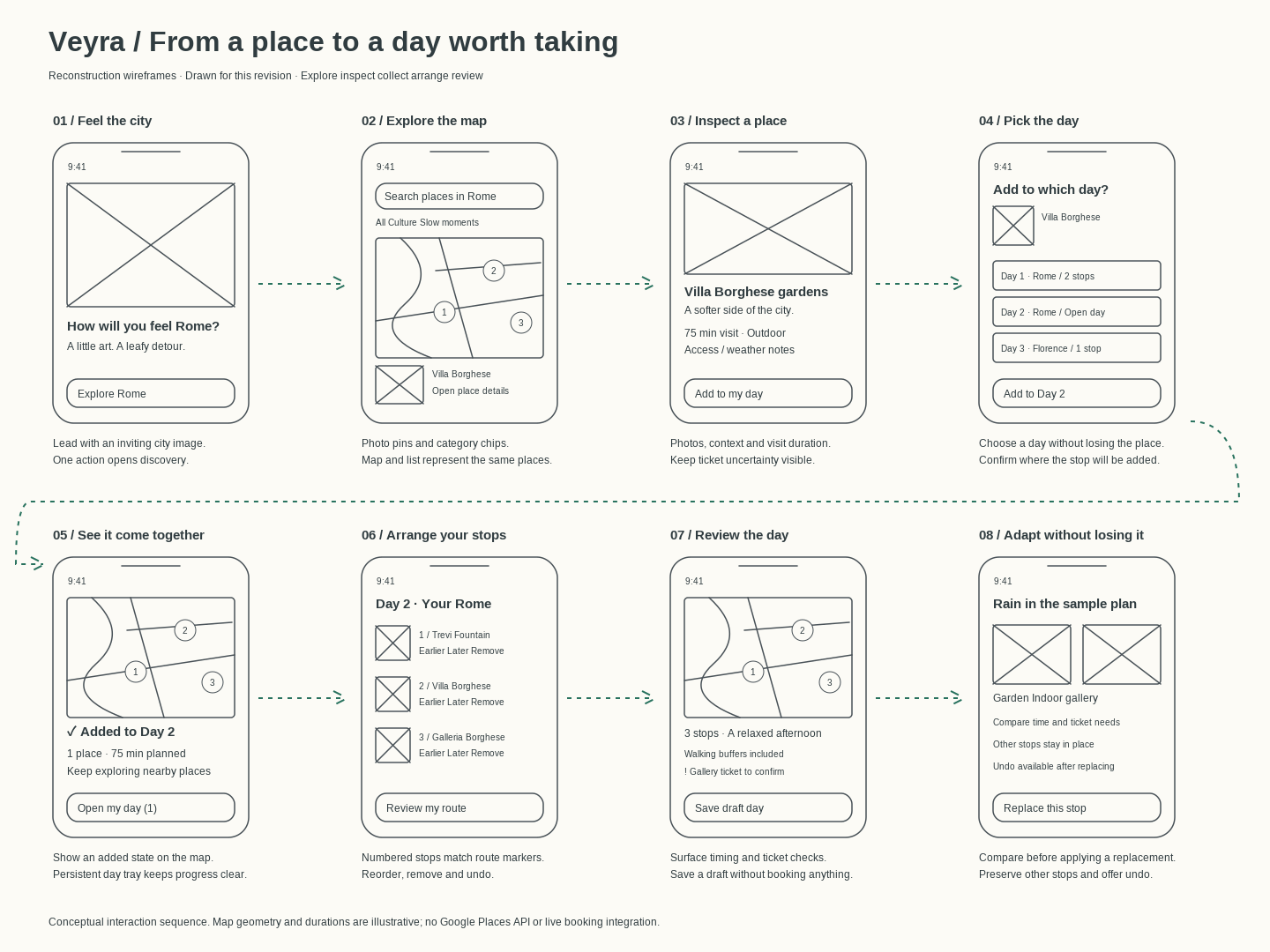
Wireframes created during the design process.
Same place, same identity
One identity across the map, card and itinerary.
Progress stays in sight
A day tray shows what was added and where.
A safe way back
Preview a replacement. Undo a removal. Keep the rest.
05 / The experience direction
Three views.
One shared plan.
Screen direction developed from the journey strategy.
9:41 ●●● ▰
ROME / DISCOVER
Follow your
curiosity.
⌕ Places, neighborhoods, moments
Route mapVilla Borghese gardensA softer side of the city
See the city before choosing.
Photo pins invite exploration. A list offers another way in.
9:41 ●●● ▰
A MOMENT TO SLOW DOWN
Villa Borghese
gardens
Leafy paths, a little water, and room to wander.
75 min
Suggested visitOutdoor
Weather sensitive
Suggested visitOutdoor
Weather sensitive
Check local access and conditions before visiting.
Balance feeling with context.
See the feeling, the time needed and the practical details.
9:41 ●●● ▰
DAY 2 / ROME
A day that
feels like you.
1
Trevi Fountain40 min · Suggested visit
⋮ Walking buffer
2
Villa Borghese75 min · Suggested visit
⋮ Room for a break
3
Galleria BorgheseTicket to confirm
Reorder your stops. Leave room for the unexpected.
Watch the day come together.
Reorder stops. Watch the route change. Leave breathing room.
Beyond the ideal path
Good planning also
makes room for change.
Rain changes one stop. It shouldn’t unravel the whole day.
- Compare visit time and ticket needs.
- Keep the other stops in place.
- Confirm before changing the day.
- Offer undo after the change.
Visual identity
Optimism with
a sense of direction.
A folded wing. Confident blue. Warm cream. A little anticipation.
 veyraA little plan. A world of possibility.
APP TYPEFACE / DM SANSAa
Clear hierarchy.
Friendly proportions.
Room to breathe.
Journey blue#075FCC · Actions
Deep ink#102E43 · Reading
Warm cream#F8F5EC · Canvas
Open sky#DEEDFA · Surfaces
Coral#ED8E78 · Accent
“Review your plan.”
Say “added” for a place. Reserve “confirmed” for a verified booking.
Experience / Compare the versions
Two versions.
One current starting point.
Use Version 2 to evaluate the revised planning interaction. Version 1 preserves the earlier configure-first sequence and its wider trip concept.
Version 1 · Earlier Figma screens and prototype
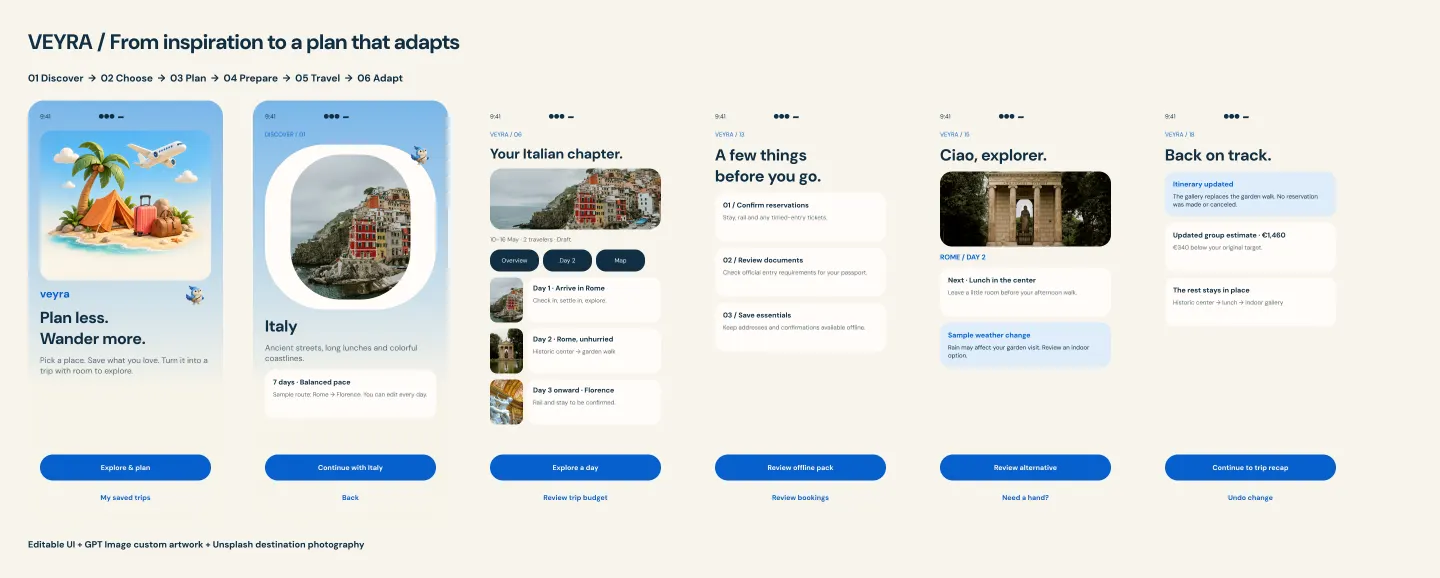
Figma sharing permissions apply. Use the Version 1 direct link if the embed cannot load. These screens document the earlier sequence.
This is a design comparison, with no observed traveler outcome yet. Live navigation, booking, payments, multi-day persistence and collaboration remain outside Version 2.
06 / Test next
Can they build it?
Can they change it?
Three tasks for the next traveler study. Traveler-study tasks.
Build a day
Find three places. Add them to the intended day.
Read the route
Explain the order, travel time and ticket checks.
Change your mind
Replace one stop. Undo it without losing the rest.
Research plan, criteria & accessibility checks
Recruit 6–8 recent trip planners, including group organizers and travelers with access needs. Observe their current tools before testing the journey.
| Study task | Observe | Acceptance target |
|---|---|---|
| Find three places and add them to a day | Search behavior, lost context, correct day selection | At least 6 of 8 complete without facilitator rescue. |
| Explain the day’s route | Map/list correspondence and timing comprehension | At least 6 of 8 identify stop order and one travel buffer. |
| Replace a stop, then undo it | Awareness of changes and retained stops | At least 6 of 8 restore the original plan unaided. |
| Identify what is not booked | Distinction between saved, planned and confirmed | All participants identify an unresolved ticket requirement. |
Report qualitative counts, not population-wide success rates. Check keyboard navigation, a list alternative to the map, text scaling, empty states and clear booking status.
A COMPLETE TASK
Follow the decision, including recovery.
Explore and add
Find a place through the searchable list, inspect it and add it to the day.
Read the shared plan
Map numbering and the ordered list describe the same stops. Visit estimates are editable.
Resolve a conflict
Shorten a visit or remove a stop when the day exceeds the chosen end time. Ticket checks remain unresolved commitments.
Change and undo
Use buttons to reorder, replace a weather-sensitive stop or remove one, then restore the prior plan.
Inspect the current interaction
Alternative considered and selection criteria
- Alternative
- Configure preferences before seeing places
- Chosen direction
- Explore places and build a day alongside the map
- Reason and cost
- A concrete day gives the setup context; list parity and explicit time constraints are needed to keep the map usable.
DECISIONS AND TRADEOFFS
Why this behavior earns its place.
Places before configuration
The original flow asked for preferences before giving a sense of the city. The revised study lets people inspect places and build a day while constraints remain visible.
Tradeoff. A visual map needs an equivalent list and keyboard controls; a place’s practical conditions must not disappear behind photography.
Reversible changes
Deleting or moving a stop should not silently disturb the rest of the day. Explicit order controls and undo make the effect inspectable.
Tradeoff. A route preview is a planning aid, not verified walking directions or a provider reservation.
Show unresolved constraints
Estimated duration, ticket checks and a chosen day end make overfull plans visible. A saved gallery stop is never presented as a confirmed ticket.
Tradeoff. Current sample data is illustrative. Opening hours, access and live availability still require a service integration.
WHAT THE WORK ESTABLISHES
Delivery, observation and next evidence.
| Evidence | What you can inspect | What remains unestablished |
|---|---|---|
| Earlier iteration | A 24-screen Figma journey and existing wireframes document the configure-first work. | The portfolio does not imply that the revised map-first flow has been synchronized to that Figma file. |
| Current iteration | The local visual planner implements collection, route order, removal, undo and constraint review. | This is a prototype with illustrative map geometry and times, not a live travel service. |
| Learning | The shift followed project review, as documented in the case. A traveler protocol is prepared. | The proposed study tests adding, reordering and removing stops. |
- Earlier iteration
What you can inspectA 24-screen Figma journey and existing wireframes document the configure-first work.
What remains unestablishedThe portfolio does not imply that the revised map-first flow has been synchronized to that Figma file.
- Current iteration
What you can inspectThe local visual planner implements collection, route order, removal, undo and constraint review.
What remains unestablishedThis is a prototype with illustrative map geometry and times, not a live travel service.
- Learning
What you can inspectThe shift followed project review, as documented in the case. A traveler protocol is prepared.
What remains unestablishedThe proposed study tests adding, reordering and removing stops.
The interaction examples make design decisions inspectable. Participant findings, endorsements and business outcomes are included only when an actual record is available.
Reflection / What the iteration changed
Make time as editable as the route.
The key shift: help travelers imagine the day before asking them to organize it.
Keep
Keep map pins and the place list connected to the same day. Explicit ordering and undo make a change visible without silently replacing the other stops.
Change next
Let the traveler adjust visit estimates when the day is overfull. The current planner updates timing from those edits, retains the last valid calculation after an invalid value, and labels ticket checks separately.
Question to test
Does exploring places first help people build and revise a workable day compared with the earlier configure-first flow? The two versions are available for a real comparative task study.